
The Cycle of Assessment
Assessment is an ongoing method focused on grasping and enhancing student learning, it is a powerful tool to improve student learn in their courses and programs. We systematically define and modify outcomes, identify measuring tools, teach/assess, analyze/report, and act/plan then take action to measure how well students’ learning aligns with our intended outcomes.
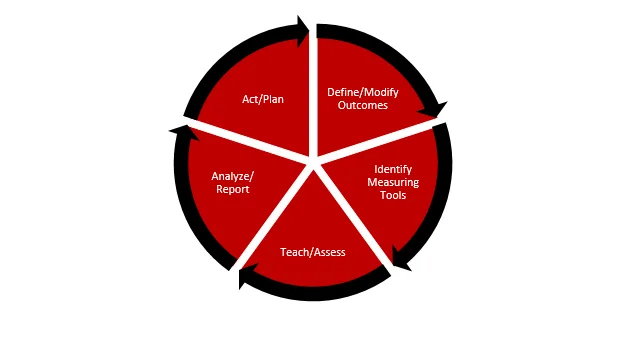
Define/Modify Outcomes
What Are Learning Outcomes? Why Do We Use Them?
Learning outcomes capture the specific and measurable skills, abilities, knowledge or values students should demonstrate upon completing a course or program. Like goals, they are directly measurable but are more specific to the components of the class. They help focus on the learning planned at that stage of the course or program. Creating measurable learning outcomes is the initial step in evaluating student learning. To assess learning effectively, we need to formulate questions for classes, courses, programs or cocurricular activities.
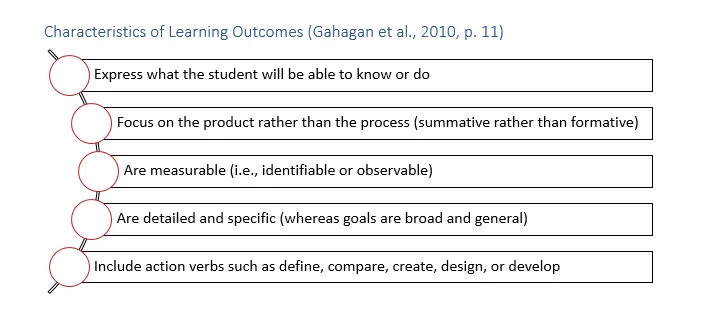
What Makes a Good Outcome?
Starting with an actionable verb for an outcome is key. We have created the Bloom’s Taxonomy (Revised) Educational Learning Outcomes handout to help you determine a strong, actionable verb. If you pair a strong actionable verb with a clear skill or knowledge the student needs to understand the content, that makes a strong outcome.
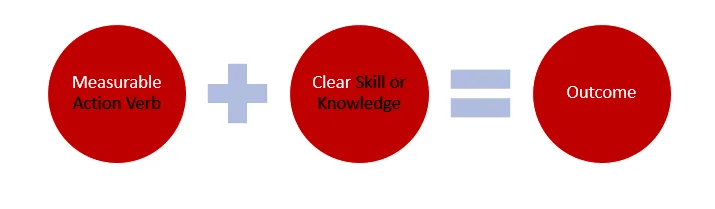
Example of Good Outcomes
At the successful completion of this course, students will be able to:
- debate a controversial issue using multiple perspectives and evidence.
- solve for components of an obtuse triangle.
Example of Bad Outcomes
At the successful completion of this course, students will be able to:
- listen to the concerns of others.
- demonstrate an understanding of how to assess and manage pain.
- know how to use a tire gauge.
Key Questions to Consider
- What specific outcomes should students achieve in this course or program? Do these align with those listed on the Course Information Form or Program Development Form? (Ensure they are meaningful and relevant.)
- What Laker Learning Competencies are addressed in this course or program? View Competencies here
- What particular knowledge or skills should students acquire in this course or program? (Ensure these are meaningful.)
- What is the current level of students’ understanding and knowledge? (This should be actionable.)
- Which outcomes do students find most challenging? (Ensure these are meaningful and relevant.)
Learning Excellence Committee Assessment Guidance
In addition to establishing the committee as an active, working partner in the assessment cycle, we knew it was time to reset the LLCFA Assessment Participation Document that was approved in 2014. This was the bulk of our conversation for the academic year. While the pilot faculty helped the Assessment Office test HelioCampus and LLC-developed training (tutorials and Canvas guidance), the committee discussed how it would operate effectively to achieve continuous improvement and ensure faculty support, voting on pivotal elements as we reached consensus. In May 2026, 11 faculty committee members voted in favor of the revisions presented in the Learning Excellence Committee Assessment Guidance.
References
Gahagan, J., Dingfelder, J., & Pei, K. (2010). A faculty and staff guide to creating learning outcomes. University of South Carolina.